This policy template has been created for community organizations that work with or support people who use substances. The purpose of the policy template is to provide organizations with standardized procedures and practices that can be used to create person-centered, recovery-oriented, and stigma-free environments. The template is universal in that it can be applied and adapted to a wide range of community service settings, including treatment centres, healthcare facilities, emergency response services, justice-oriented organizations, and others. It is shaped by four guiding principles and includes practical strategies and approaches that staff at varying levels of the organization can adopt within their practice.
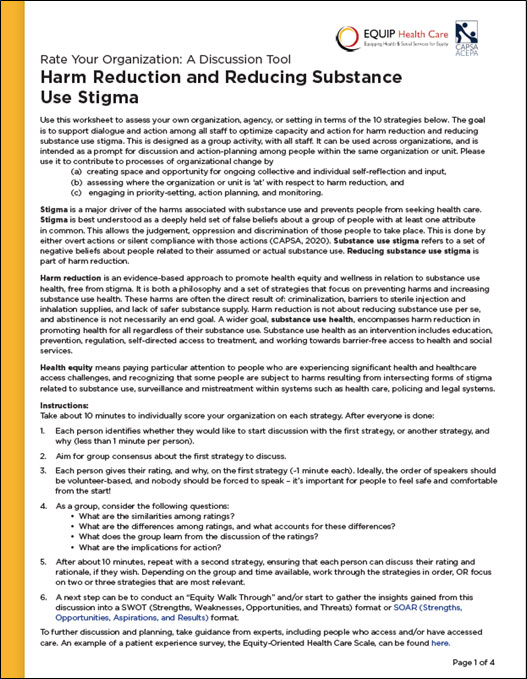
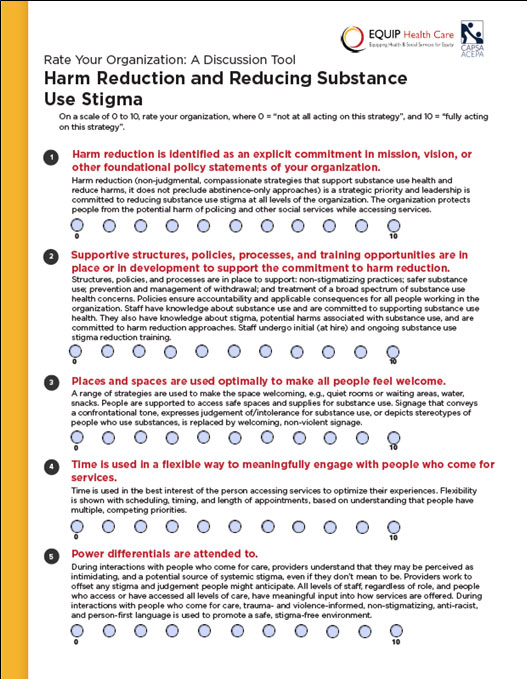
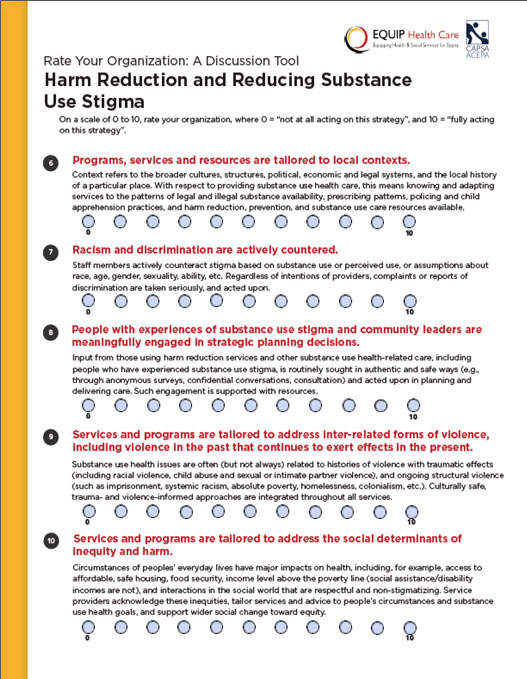
Equip Health Care’s “Rate Your Organization: Discussion Tool” (Appendix A) is a checklist tool designed to assess and score how well harm reduction and anti-stigma strategies are reflected in practice. It offers valuable insights into how organizations or agencies can function in ways that promote person-centered, recovery oriented and stigma free environments.
For questions or guidance on implementing this policy in your service setting, please contact Emma Salmon, Health Promotion Specialist at the Windsor-Essex County Health Unit, via email at esalmon@wechu.org.
Substance-related mortality, emergency department visits, and hospitalizations have been on the rise in Windsor-Essex County. These outcomes are often linked to substance use d and addressing them requires confronting the stigma surrounding this condition. Research shows that stigma is rooted in the misconception that substance use disorder is a personal choice or moral failing (McGinty, E. E., & Barry, C. L. (2020). Hence, there is a need to shift public perceptions to promote empathy and understanding, ultimately leading to better health outcomes for people who use substances.
Stigma creates barriers at individual, system, and societal levels—preventing people from seeking help, reducing the quality of care they receive, and fueling punitive responses instead of public health solutions. As stigma persists across communities and professional settings, it is critical to promote respect, dignity, and equity. Fostering judgment-free environments for people who use substances and/or harm reduction practices can be achieved through education, trauma-informed care, and the use of non-stigmatizing language.
The purpose of this policy is to guide [Service Agency/Organization Name] in fostering an environment where people with lived or living experience (PWLLE) of substance use and/or harm reduction are not burdened by stigma that limits access to care or opportunities for upward social mobility, ultimately supporting improvements in their quality of life. As such, all management, service providers, and human resource personnel are expected to adhere to the full policy within its scope.
The following key terms are provided to support staff in recognizing the underlying beliefs, assumptions and attitudes that may unintentionally create barriers between service providers and people who use substances and/or harm reduction practices. Understanding these terms is essential to the effective implementation of this policy and to promoting equitable, respectful and compassionate care across all programs and services. These include:
Anti-stigma approaches
Approaches that address stigma drivers and practices by targeting social norms as well as public policy. Anti-stigma approaches recognize substance use as a health issue and encourage compassionate, evidence-based responses rather than judgement.
Anti-stigma approaches include but are not limited to:- Harm reduction
A client-centered, evidence-based approach that reduces the health, social, and economic harms of substance use. It promotes safer use, prevents overdose and disease transmission, and strengthens connections to care. Examples include Needle Syringe Programs and opioid agonist therapies including Methadone and Suboxone. It is important to support harm reduction as a valid care option, recognizing that recovery is not linear and committing to meeting individuals where they are at. - Trauma and Violence-Informed Practice (TVIP)
A service approach that acknowledges the widespread impact of trauma and violence. TVIP fosters safe, empowering environments that prevent re-traumatization and support people who use drugs (PWUD) in making informed, self-directed choices. - Equity and Inclusion:
An approach that affirms the rights and dignity of all individuals, regardless of substance use, race, ethnicity, or gender. It centers client voices, respects autonomy, and supports informed decision-making. - Collaboration with People with Lived and Living Experience
Equitable partnerships with PWLLE are essential to addressing power imbalances and improving accessibility. Their insights help shape services that are responsive, inclusive, and effective in meeting real-world needs. - Person-first language
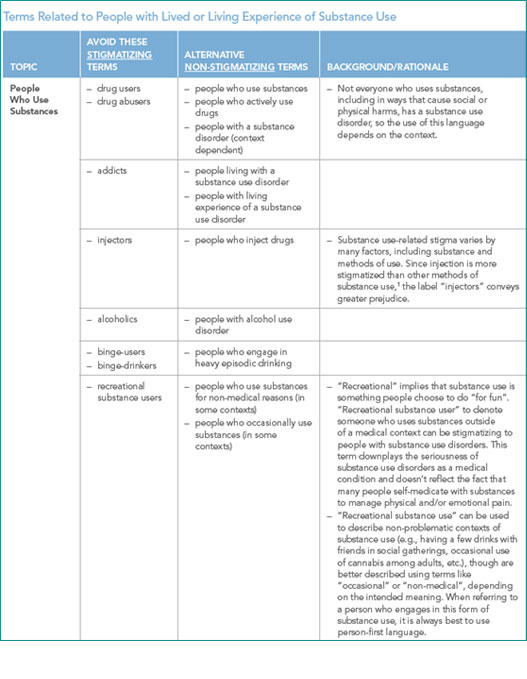
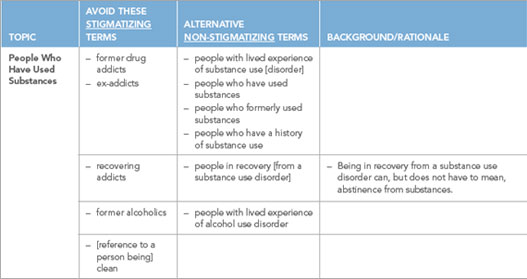
Language that puts the individual before their condition or behavior. It emphasizes the person rather than defining them by their substance use or engagement with harm reduction practices. For example, using “person who uses substances” instead of “addict” promotes inclusivity and helps avoid terms that are considered harmful. Additionally, respectful language supports clearer, more accurate communication with the people who access our services.
- Harm reduction
Approved terms include, but are not limited to:
- People who use substances
- People with a substance use disorder
- People living with a substance use disorder
- People who use drugs
- People in recovery
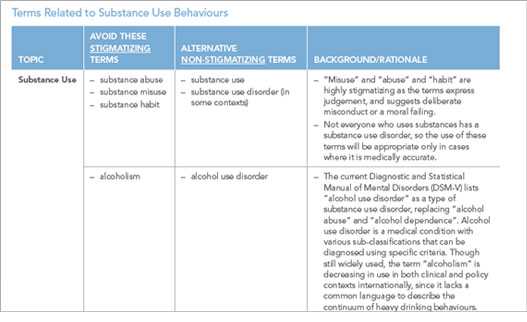
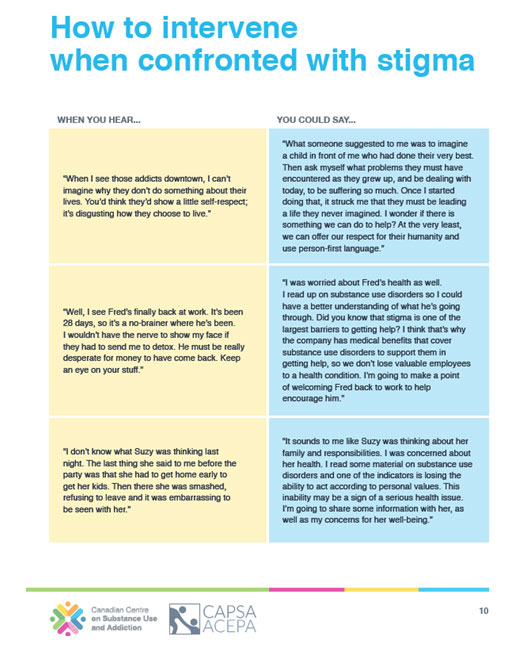
These terms can be used in both singular and plural contexts—for example, individual(s), client(s), patient(s), and people who use substances. For a comprehensive list of stigmatizing and non-stigmatizing, substance use–related terms, please refer to Appendix B. For guidance on how these concepts can be implemented in conversation, see Appendix C.
- Substance use
The consumption of psychoactive substances – including currently illegal drugs, as well as alcohol, tobacco, and cannabis – that can be used for medical, religious or ceremonial purposes, for personal enjoyment or pleasure, or to deal with stress, trauma or pain. Substance use can be viewed on a spectrum, from beneficial to low risk to potentially leading to higher-risk use and substance use disorders that impact overall health and well-being. - Substance use disorder (SUD)
A medical condition characterized by the uncontrolled use of a substance despite harmful consequences. It can range in severity and is treatable through a variety of evidence-based approaches. - Lived or living experience
The knowledge and perspective gained through personal experience with substance use, including active use, previous use, recovery, treatment, and/or harm reduction. Living experience refers to individuals who are currently using substances. - Stigma
Negative attitudes, beliefs, or behaviors directed at individuals or groups based on perceived differences or characteristics—such as substance use—that lead to discrimination, exclusion, or reduced access to services. - Discrimination
Negative behaviours towards people who deviate from societal norms or, in other words, those who are stigmatized. Discriminatory practices result in exclusion and maintain inequities for the stigmatized group. - Structural stigma
Systemic policies, practices, or institutional norms that create or maintain barriers to care, support, or opportunities for people who use substances. - Individual stigma
When individuals accept and apply negative stereotypes to themselves, which can reduce self-esteem, discourage help-seeking, and impact recovery.
Management
Management of [Service Agency/Organization Name] will ensure that this anti-stigma policy is applied fairly, consistently, and confidentially. They are responsible for determining the validity of any allegations and deciding on appropriate corrective actions when necessary. To foster a stigma-free environment, Management will:
- Provide ongoing education and awareness training related to substance use and stigma reduction seeTraining & Education Resources.This includes annual completion of the anti-stigma e-learning module developed by the WECHU.
- Regularly review organizational policies, practices, and systems to identify and eliminate language from all written materials, procedures, and communications which would stigmatize people who use substances.
- Ensure an accessible, fair, and confidential process for addressing complaints related to stigma or discrimination.
- Model inclusive, respectful, and stigma-free behaviors at all times.
Service Providers
Service Providers within [Service Agency/Organization Name] play a crucial role in delivering care and support free of stigma and judgment related to substance use and/or harm reduction practices. They are responsible for:
- Demonstrating respectful, non-judgmental, and compassionate attitudes towards all clients, regardless of their substance use status.
- Incorporating substance use stigma awareness and reduction strategies into their daily interactions and professional practices.
- Maintaining client confidentiality and handling all situations with sensitivity and respect.
- Reporting any observed stigma or discrimination within the workplace or service environment through appropriate channels.
- Participating in training and educational opportunities aimed at improving understanding and reducing stigma related to substance use.
Human Resources
Human Resources are responsible for sustaining a culture of inclusion related to substance use through training, onboarding and communications. Human Resources are responsible for:
- Promoting a general understanding of this Policy.
- Promoting and monitoring the implementation of this Policy.
- Recognizing individual needs and facilitating timely and appropriate referral pathways to substance use and mental health services, as needed.
- Promoting accountability by responding to reports of Policy violations with appropriate corrective and where necessary, disciplinary action.
Implementation
To uphold [Service Agency/Organization Name]’s commitment to fostering an environment where individuals with lived and living experience of substance use and/or engagement with harm reduction practices are accepted, valued, and treated with dignity, the following guiding principles should be embedded across all programs and services.
Integrating these principles ensures that all staff, including volunteers, employees, administrators, and board members, share a common understanding of what constitutes a supportive, inclusive, and non-stigmatizing environment.
The following section outlines implementation strategies for each guiding principle to support service providers and management in their engagement with people who use substances.
Harm Reduction
It is important to deliver services in a way that supports and welcomes clients with lived and living experience of substance use. A harm reduction approach helps build rapport and trust with individuals who are often marginalized or discriminated against, thereby creating low-to no-barrier access to care.
Management and Human Resources
- Ensure there is an organizational culture where clients feel safe to talk about harm reduction.
- Ensure staff have a consistent understanding of the policy and implement it in alignment with its intended purpose and principles.
- Require all new hires (staff, student, volunteers) to complete anti-stigma training focused on substance use and harm reduction. All staff must participate in annual refresher training.
Promote ongoing opportunities for education and training on harm reduction to support a shift in organizational perspectives
Service Providers
- Cultivate a welcoming and comfortable environment (e.g., be non-judgemental and listen actively).
- If an individual discloses their experience with substance use and/or harm reduction, respond in an open and supportive manner, recognizing that past experiences may influence the individual’s current circumstances and needs.
- Maintain and protect confidentiality (e.g., do not gossip about service users).
- Recognize client needs and facilitate appropriate referral pathways to harm reduction services as needed.
Trauma and Violence-Informed Practice
Management and Human Resources
- Support hiring practices that prioritize candidates with an understanding of the intersection between harm reduction, trauma and violence (e.g., job postings will include a requirement for demonstrated understanding of trauma-informed care).
Provide training for all staff on the links between trauma, violence, and health outcomes and behaviours—including awareness of vicarious or secondary trauma (e.g., trauma-related symptoms from exposure to trauma stories or experiences of others).
Support staff engagement in professional development by sharing and promoting participation in trauma and violence-informed practice training sessions, particularly when training content aligns with staff roles and enhances service delivery.
Service Providers
- Acknowledge the potential impact of trauma without asking individuals to disclose personal experiences.
- Recognize that clients come from diverse backgrounds and that trauma may shape their current experiences and responses; listen, believe, and validate experiences with understanding and respect
- Acknowledge and build upon each client’s resilience and strengths while acknowledging the impact of their experiences.
- Express genuine concern and care in all interactions to foster trust and connection.
Equity & Inclusion
Management and Human Resources
- Create and maintain a workplace that is supportive and judgement-free.
- Set expectations, create opportunities, and provide space for collaborative relationships to be formed between client and service provider (e.g., client feedback loop).
- Report areas where there may be barriers to equal opportunities for PWLLE with substance use and/or harm reduction practices.
- Provide process guidance to claims of systemic stigma towards PWLLE with substance use and/or harm reduction practices.
Service Providers
- Provide choices for care and discuss choices together, supporting person-centered decision-making. Communicate openly, listen actively, and respond respectively to foster understanding and trust without judgement.
- Provide a safe space for clients to express their feelings and emotions freely.
- Listen carefully to the client's words and check in to make sure that you have understood correctly.
- Report incidents of stigma, whether intentional or not, so that appropriate action can be taken.
Collaboration with People with Lived and Living Experience (PWLLE)
Management and Human Resources
- Ensure that the outlined actions are in full compliance by service providers.
- Promote client-centred care as an integral part of organizational culture.
- Facilitate opportunities for PWLLE to inform design and deliver of services/programs where applicable (e.g., engage with the WECHU Substance Use Peer Advisory Committee to gather input on new initiatives).
- Compensate PWLLE fairly for their time and expertise in alignment with best practice guidelines.
Service Providers
- Client-centered care is essential to ensuring conditions that empower and support PWLLE to be safer and healthier, informed and make decisions about the types of services or treatments that best meet their felt needs. Practical steps for incorporating client-centered care include:
- Establishing a respectful and non-judgemental environment where staff are trained in harm reduction and trauma-informed communication, and assumptions are not made about their substance use, readiness for change or treatment preferences.
- Involving PWLLE in evaluation and decision-making processes to ensure programs and services respond to population needs.
- Creating meaningful opportunities for PWLLE to contribute to the design and delivery of substance use prevention, harm reduction, and anti-stigma initiatives.
- Creating feedback loops so contributors can see how their input has shaped decisions and program development and understand how well their needs are being met.
- Presenting a full range of options that clearly outline available supports, services, and treatment pathways – avoiding the promotion of a fixed path to treatment and recovery.
- Obtaining informed consent, presenting information in clear and plain language to ensure clients understand the benefits, risks and alternatives of each option before deciding.
- Supporting autonomy, by empowering clients to choose services or interventions that align with their values and goals, while also respecting their right to decline services or revisit decisions anytime.
- Mandatory Participation: All staff and management who work with or support the care of PWLLE must complete anti-stigma training on an annual basis, or more frequently as needed (e.g., following staff turnover, reported incidents or identified service gaps).
- Training Content: Trainings will be grounded in harm reduction and trauma informed principles, with a focus on reducing stigma related to substance use and/or harm reduction practices. Recommended resources – such as those developed by CAPSA (Community Addictions Peer Support Association) – will be used to guide content (see Training Education Resources).
- Training Delivery: Trainings may be delivered in various formats, including in-person sessions, live webinars, or pre-recorded e-modules, depending on availability and staff needs.
- Training Schedule:
- Annually for all relevant staff
- During onboarding for new hires including staff, volunteers, and students
- Following a policy breach or as part of a corrective action plan
Disciplinary action may be taken in cases of repeated non-compliance, such as the use of inappropriate language or engagement in behaviour that may be perceived as stigmatizing. Individuals identified as non-compliant will receive appropriate educational training to support awareness and behaviour change. Relevant education and training materials are available in the Appendices.
British Columbia Centre of Excellence for Women’s Health. (2013). Trauma-informed practice guide. https://cewh.ca/wp-content/uploads/2012/05/2013_TIP-Guide.pdf
Canadian Centre on Substance Use and Addiction. (2019). Overcoming stigma through language: A primer. https://www.ccsa.ca/sites/default/files/2019-09/CCSA-Language-and-Stigma-in-Substance-Use-Addiction-Guide-2019-en.pdf
Canadian Drug Policy Coalition. (n.d.). A critical terminology guide to the drug policy reform movement. https://drugpolicy.ca/critical-terminology-guide/
Canadian Public Health Association. (n.d.). Language matters: Using respectful language in relation to sexual health, substance use, STBBIs, and HIV. https://www.cpha.ca/sites/default/files/uploads/resources/stbbi/language-tool-e.pdf
Canadian Public Health Association. (n.d.). A new framework for a public health approach to substance use. https://www.cpha.ca/framework-public-health-approach-substance-use
EQUIP Health Care, Community Addictions Peer Support Association. (2022). Rate Your Organization: Harm Reduction and Reducing Substance Use Stigma. A Discussion Tool. Vancouver, BC. www.equiphealthcare.ca
McGinty, E. E., & Barry, C. L. (2020). Stigma reduction to combat the addiction crisis—Developing an evidence base. New England Journal of Medicine, 382(14), 1291–1292. https://doi.org/10.1056/NEJMp1917360
Public Health Agency of Canada. (2019). Communicating about substance use in compassionate, safe and non-stigmatizing ways: Guiding principles. https://www.canada.ca/content/dam/phac-aspc/documents/services/publications/healthy-living/communicating-about-substance-use-compassionate-safe-non-stigmatizing-ways-2019/guilding-rinciples-eng.pdf
Public Health Agency of Canada. (2020). Addressing stigma: Towards a more inclusive health system. https://www.canada.ca/en/public-health/services/publications/healthy-living/primer-reduce-substance-use-stigma-health-system.html
Province of British Columbia. (n.d.). Overdose prevention and response glossary. https://www2.gov.bc.ca/assets/gov/overdose-awareness/overdose_prevention_glossary.pdf
CAPSA Substance Use Health Framework
CAPSA Stigma Ends with Me Webinar (offered at cost)
CCSA CAPSA Overcoming Stigma Through Language
CATIE Harm Reduction Fundamentals: A Toolkit for Service Providers
CPHA Challenging Structural Substance Use Stigma Package | Online Delivery
CPHA Challenging Structural Substance Use Stigma Package | In Person Delivery